Martes, Mayo 20, 2014
Search for Missing Yacht in North Atlantic
Last week a 12m yacht, the "Cheeki Rafiki", sailing from Caribbean to UK, started taking on water in mid-Atlantic. They were obviously in a serious situation and contact with the yacht was lost early hours of Friday when about 600 miles off Cape Cod, Massachusetts. A search was started by the United States Coast Guard and the upturned hull of a sailboat was spotted by a tanker crew that reported it but did not investigate further. The search was called off by USCG on Sunday, about 48 hours after the search started.
The USCG press release said "We appreciate the assistance of the U.S. Air Force, Canadian and the three merchant vessels helping us to conduct a thorough search so far from shore," said Capt. Anthony Popiel, 1st Coast Guard District chief of response. "We are extremely disappointed that we were not able to locate the sailors during the course of this extensive search. Our thoughts and prayers are with their families during this difficult time."
There followed a huge outcry against calling off the search so soon and it has been resumed today. This was after many thousands of people signed petitions calling on the USCG to resume the search and many private yacht owners vowed to go out there in their own boats to search if the USCG would not do it.
I have some questions.
1) Isn't it a primary function of the USCG to go out there and search for whoever is missing or in trouble? This is a department of US government, paid for by the people. Is it that strapped for cash that it can't search longer than 48 hours for four people who are in dire straits, when they have a pretty good idea of where they are?
2) We have watched with fascination how carefully the Southern Indian Ocean has been searched for a missing aircraft. I accept that searching for a missing yacht or liferaft with four people aboard can't be compared with a search for a plane with hundreds. But they know where this boat is, it was even seen from a ship. They are not guessing or relying on foggy evidence to locate a start point for the search. The boat is there and it is/was afloat. If the crew abandoned ship into the liferaft, as seems the most likely scenario, the raft is likely to be downwind or downcurrent, or a combination of the two, of the position of the abandoned yacht. Why would the USCG assume that the crew were in the water and unable to survive when they had a liferaft available for just such an emergency? People have survived for many months in liferafts, surviving tumultuous storms and everything else that nature has thrown at them before eventually being found.
3) Isn't it maritime law that seamen are required to assist each other when in distress? A report in Metro News says that "the overturned hull of the boat was spotted by a passing tanker shortly after they disappeared but it was not inspected as there was no sign of the crew". People have survived in capsized or even sunken boats for considerable time, about two weeks in the most recent case. Why would the captain of the ship not stop his vessel and investigate. He saw the capsized boat. Unless it was storm conditions he should have been able to launch a boat to cross to the yacht. Banging on the hull and listening for a response would have told them if anyone was alive inside. Seeing it, reporting it and moving on did nothing to assist the crew aside from recording a start point for the search. Is commercial profit so important to the ship's owners that they would not do everything in their power to ascertain that there was nobody there to rescue?
Thanks for reading my rant.
Read More..
The USCG press release said "We appreciate the assistance of the U.S. Air Force, Canadian and the three merchant vessels helping us to conduct a thorough search so far from shore," said Capt. Anthony Popiel, 1st Coast Guard District chief of response. "We are extremely disappointed that we were not able to locate the sailors during the course of this extensive search. Our thoughts and prayers are with their families during this difficult time."
There followed a huge outcry against calling off the search so soon and it has been resumed today. This was after many thousands of people signed petitions calling on the USCG to resume the search and many private yacht owners vowed to go out there in their own boats to search if the USCG would not do it.
I have some questions.
1) Isn't it a primary function of the USCG to go out there and search for whoever is missing or in trouble? This is a department of US government, paid for by the people. Is it that strapped for cash that it can't search longer than 48 hours for four people who are in dire straits, when they have a pretty good idea of where they are?
2) We have watched with fascination how carefully the Southern Indian Ocean has been searched for a missing aircraft. I accept that searching for a missing yacht or liferaft with four people aboard can't be compared with a search for a plane with hundreds. But they know where this boat is, it was even seen from a ship. They are not guessing or relying on foggy evidence to locate a start point for the search. The boat is there and it is/was afloat. If the crew abandoned ship into the liferaft, as seems the most likely scenario, the raft is likely to be downwind or downcurrent, or a combination of the two, of the position of the abandoned yacht. Why would the USCG assume that the crew were in the water and unable to survive when they had a liferaft available for just such an emergency? People have survived for many months in liferafts, surviving tumultuous storms and everything else that nature has thrown at them before eventually being found.
3) Isn't it maritime law that seamen are required to assist each other when in distress? A report in Metro News says that "the overturned hull of the boat was spotted by a passing tanker shortly after they disappeared but it was not inspected as there was no sign of the crew". People have survived in capsized or even sunken boats for considerable time, about two weeks in the most recent case. Why would the captain of the ship not stop his vessel and investigate. He saw the capsized boat. Unless it was storm conditions he should have been able to launch a boat to cross to the yacht. Banging on the hull and listening for a response would have told them if anyone was alive inside. Seeing it, reporting it and moving on did nothing to assist the crew aside from recording a start point for the search. Is commercial profit so important to the ship's owners that they would not do everything in their power to ascertain that there was nobody there to rescue?
Thanks for reading my rant.

Huwebes, Mayo 15, 2014
Capsizing Big Sailboats
The article about our January capsize in the Cape to Rio Race is now in print in Professional Boatbuilder magazine. It is also available in digital form to print subscribers. This publication is free but is only available to members of the boating industry. Click to see the contents of the current issue.
In retrospect, the thing that amazes me most about this event is this. I was upright, walking through the boat at the time, heading for the cockpit. I was unaware that we were being capsized until the cabin roof hit the water at the bottom of the wave, with the boat well rotated toward upside-down. It happened very fast, with the boat moving through an arc that must have applied large centrifugal forces, enough for me to be well past horizontal and still walking on the cabin sole. Everything else in the boat stayed in place through that process as well, only becoming dislodged when we impacted the bottom of the wave.
Those who don't have access to the magazine can read about our capsize in my January posts on this blog.
Visit our website at http://dixdesign.com/.
Read More..
 |
| Graphic from Professional Boatbuilder magazine of the start of the capsize. |
Those who don't have access to the magazine can read about our capsize in my January posts on this blog.
Visit our website at http://dixdesign.com/.
Martes, Mayo 13, 2014
Paper Jet to Okoumefest
Every year in May Chesapeake Light Craft hosts a demo day on Kent Island, in northern Chesapeake Bay. This is to give potential home builders the opportunity to test the various boats ahead of buying a kit. CLC cut the CNC kits for our plywood boats in USA, so we join the happy day of boating on the beach.
We had a two Paper Jets there last year and I will have my own yellow prototype, PJ #1, there again this year. Those who want to test sail her, please join us on the beach at Matapeake State Park, between 9am and 5pm.
Paper Jet sail numbers are now up to 84 and growing. This is a fun boat to sail. Come along to Okoumefest to see and sail her for yourself.
To see more about this design and the others in our wide range, please visit http://dixdesign.com/.
Read More..
We had a two Paper Jets there last year and I will have my own yellow prototype, PJ #1, there again this year. Those who want to test sail her, please join us on the beach at Matapeake State Park, between 9am and 5pm.
 |
| Dudley preparing PJ #007 for sailing, Okoumefest 2013. |
 |
| PJ #007 returning from a test sail, Okoumefest 2013. |
 | |
| PJ #001 patiently waits on the beach for her turn to be rigged. Okoumefest 2013. |
To see more about this design and the others in our wide range, please visit http://dixdesign.com/.
Sabado, Mayo 10, 2014
Didi Mini Mk3 Kit from CKD Boats
I would have to dig deep in my files to find when CKD Boats first started cutting kits to our plywood designs. Owned by Roy McBride, this Cape Town company has the longest history of cutting our kits and has shipped kits for our plywood boats to many countries around the world. They also have the most experience with packaging large or small kits securely enough to arrive at their destination without damage or loss.
The most remote was a Didi 38 kit sent to Johnston Atoll in the North Pacific. It was a very comprehensive kit that included all plywood, complete rig, keel, engine, sterngear, galley equipment, deck hardware, pulpits, sails and even pre-cut window panels and all the cushions pre-upholstered. This was all packed into a standard 20ft container and had to be shipped via New Zealand and Hawaii, all expertly managed by Roy, his staff and his subcontractors.
CKD Boats has just completed cutting a kit for the Didi Mini Mk3 for a customer in France. It will be packed next week for shipping.
The plywood components are held in place in the sheets by thin tabs that are left between the full-depth cuts. They are released from the sheets by cutting through the tabs with a box-cutter or jigsaw. This system keeps the plywood as full 8x4 sheets for easy packaging and protection of the components from loss or damage.
The Didi Mini Mk3 is one of the first boats that I converted to jigsaw joints instead of the stepped scarph joints that we used previously. This results in easier assembly and is easier to cut, with less machine time involved. These two panels both show a narrow cut on one side and a wide cut on the other. The wide cut is at the junction between flat and radiused panels, so it has a half-depth rebate pre-cut full length of the panel for the structural joint of the radius panel to the flat sheet.
When this kit is out of the shop, the next will start cutting. This is for a Didi Sport 15 to fill an order from a South African builder.
To see these designs and others in our very broad range, please visit http://dixdesign.com/.
Read More..
The most remote was a Didi 38 kit sent to Johnston Atoll in the North Pacific. It was a very comprehensive kit that included all plywood, complete rig, keel, engine, sterngear, galley equipment, deck hardware, pulpits, sails and even pre-cut window panels and all the cushions pre-upholstered. This was all packed into a standard 20ft container and had to be shipped via New Zealand and Hawaii, all expertly managed by Roy, his staff and his subcontractors.
CKD Boats has just completed cutting a kit for the Didi Mini Mk3 for a customer in France. It will be packed next week for shipping.
 |
| Didi Mini Mk3 sheet fresh from the CNC router. |
 |
| Didi Mini Mk3 hull skin panels with jigsaw joints. |
When this kit is out of the shop, the next will start cutting. This is for a Didi Sport 15 to fill an order from a South African builder.
To see these designs and others in our very broad range, please visit http://dixdesign.com/.
Huwebes, Mayo 1, 2014
Didi 950 Radius & Clean Workshops
Mike Vermeersch has completed the first layer of the radius panel on one side of his Didi 950 hull. Although the surface is not up to final level, the hull shape is now much clearer.
In theses photos the radius skin has still to be trimmed back to hull centreline. When that is done, the shape of the forefoot as it fairs into the bow will become clear.
Thanks to Mike for these great photos. A few people have commented about the cleanliness of Mike's project and also of his workshop. I like to work clean on my boatbuilding projects but Mike takes it to a whole new level. That might be due to his engineering background.
The benefits of working this way are many. A very important one is that it is much easier to clean up runs and drips of excess glue etc before it cures than to do it later. If a lump or run of epoxy or resorcinol is allowed to cure, it will be stronger than the surface of the wood and will rip out pieces of wood while you remove it with a chisel. You also need to thump the head of the chisel with a mallet or at least your hand, to move it along. Expect occasional bruising of the palm of your hand in the process. You can grind or sand it off mechanically but that is always with a risk of damaging the surface and the equipment cannot generally get into tight corners. You can more easily remove it with a slightly blunt chisel or a scraper soon after it reaches initial cure, without risk of surface damage. Resorcinol is really nice in this way because it becomes rubbery and can be easily and very cleanly sliced off. Epoxy will drag on the tool and not trim off as cleanly, so the natural tendency is to leave it for later when it is hard.
The other major benefits of a clean workshop are that it is just so much nicer to work in a clean environment and you are less likely to hurt yourself by standing on odd-shaped bits of wood, slipping on wood shavings or gluing your shoes to the floor. I generally sweep the work area about every 2nd day or more often if I am doing something that produces lots of dust or waste.
Please visit our website at http://dixdesign.com/ to see our very broad range of boat designs for both amateur and professional boatbuilders.
Read More..
 | |
| The skin will be trimmed back to centreline when the other side is fitted. |
 | ||
| The front face of the forward bulkhead will have a wood capping. |
 | |
| Nice overall view of the hull shape. |
 |
| Clean and powerful stern sections. |
The benefits of working this way are many. A very important one is that it is much easier to clean up runs and drips of excess glue etc before it cures than to do it later. If a lump or run of epoxy or resorcinol is allowed to cure, it will be stronger than the surface of the wood and will rip out pieces of wood while you remove it with a chisel. You also need to thump the head of the chisel with a mallet or at least your hand, to move it along. Expect occasional bruising of the palm of your hand in the process. You can grind or sand it off mechanically but that is always with a risk of damaging the surface and the equipment cannot generally get into tight corners. You can more easily remove it with a slightly blunt chisel or a scraper soon after it reaches initial cure, without risk of surface damage. Resorcinol is really nice in this way because it becomes rubbery and can be easily and very cleanly sliced off. Epoxy will drag on the tool and not trim off as cleanly, so the natural tendency is to leave it for later when it is hard.
The other major benefits of a clean workshop are that it is just so much nicer to work in a clean environment and you are less likely to hurt yourself by standing on odd-shaped bits of wood, slipping on wood shavings or gluing your shoes to the floor. I generally sweep the work area about every 2nd day or more often if I am doing something that produces lots of dust or waste.
Please visit our website at http://dixdesign.com/ to see our very broad range of boat designs for both amateur and professional boatbuilders.
Huwebes, Abril 24, 2014
Didi 950 Hulls Taking Shape
The Didi 950 projects of Fred Grimminck in Australia and Mike Vermeersch in USA continue in parallel. Fred's build is from plans only and Mike's is from a kit that was cut by CNC router. Both have completed the flat sheet panels of the sides and bottom and are now skinning the radiused parts of their hulls. This is the stage that the hull shape really starts to show.
Some of the photos that I show of these two projects show minor differences, due to building from a pre-cut kit or with the builder cutting all components. Both produce the same boat at the end of the process but they may look a little different at times while being built.
The photo above is of Mike's kit boat, with neat edges at the sheer (where hull and deck will meet). The photo below is of Fred's boat with irregular edges at the sheer. This is because the kit panels are supplied with a uniform strip of waste to be trimmed off to the final line after turning the hull over, while the boat built without a kit has the panels inividually cut by the builder and the waste width may vary.
The radius is skinned in two layers, made with narrow transverse strips. The first layer lies on the stringers and the doublers of the tangent stringers, fitted between the edges of the side and bottom panels. These edges have rebates pre-cut into them and onto which the second layer will be laid.
Construction of the boat in Latvia has now started and the boat in Greece will soon follow. To see more of this design and others in our stock design range, please visit http://dixdesign.com.
Read More..
Some of the photos that I show of these two projects show minor differences, due to building from a pre-cut kit or with the builder cutting all components. Both produce the same boat at the end of the process but they may look a little different at times while being built.
 |
| Side and bottom panels all completed, ready for radius to start. |
 |
| Same stage, Fred's boat. Backbone still to be trimmed at forefoot. |
 |
| First layer of radius being fitted to Mike's boat. |
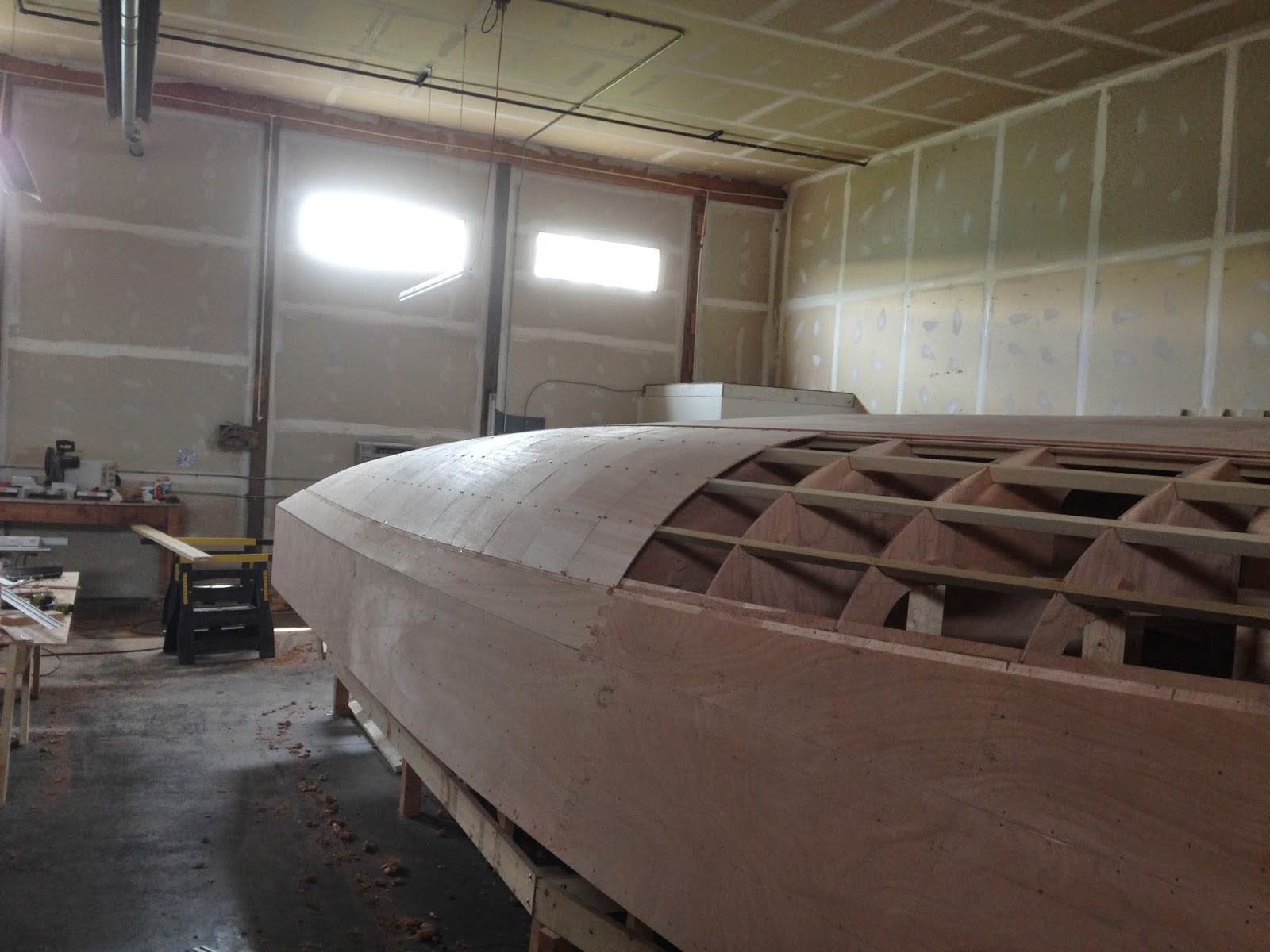 |
| The rebate along the edge of the side panel can be seen in this photo. |
 |
| Final hull shape starting to become clear. |
Lunes, Abril 7, 2014
Didi 950 Projects
There appears to be considerable interest in my posts about the boats being built to our Didi 950 design. This is a radius chine plywood design with hard chine in the topsides, designed to fit into the Classe 950 box rule. In the past few days I have received a bunch of new photos that show the build process clearly, as well as some updated progress photos.
Before going into the new photos, you might like to read the article that I posted today on my Boatbuilder Tips for Amateurs blog about how to construct building stocks or beds, the foundation off which the skeleton of a wooden boat is built. It is illustrated with photos of the Didi 950 that is being built by Fred Grimminck in Australia. The photos below are mostly of that same project, being built from scratch without a kit.
The photo below shows the various backbone components, all of which slot eggcrate-fashion into the bulkheads. The slots help to locate the bulkheads and backbones correctly relative to each other. The bow and stern have single backbone on centreline and the mid-part of the hull as two backbones that run down each side of the keel support box. The two shorter pieces on the right are the paired double-backbone parts. Next toward the left is the aft backbone, which turns up at the far end to support the transom. Extreme left is the bow backbone, which turns up at the far end to form the stem and supports a bow bulkhead into which the forward ends of the stringers are located.
The photos below show a few of the forward bulkheads with the bow backbone dry-fitted in place. The backbone has doublers just below deck level for through-bolting the bow chainplate. The doublers can be seen at the forward lower end of the backbone.
In this next photo, the transom doubler has been set up as a doubler and the stringers etc run through, then are trimmed flush. When the transom is glued over the doubler the end-grain of the longitudinals will be covered and protected. Look through the 4th cutout from left through the doubler to see how the aft end of the aft backbone turns up against the inside face of the doubler. The backbone has locating tabs that slot through the doubler, seen as light-coloured marks on centreline of the doubler. In the lower photo the transom is being glued over the outside of the doubler.
The sheer clamps on this design sit diagonally across the corner at the intersection between hull sides and decks. They are screwed and glued to cleats on the faces of all bulkheads. In this photo the sheer clamp is clamped to those cleats. You can also see how the stringers are slotted through the bulkheads. Once the hull skin has been glued on, these junctions become very strong and rigid
Looking forward along the hull just prior to fitting the bottom skin. The wide stringers on both sides are the tangent stringers, with doublers to back up the joint between flat bottom panels and radius skin panels at the turn of the bilge. The single aft backbone can be seen running through to the 3rd bulkhead from the bottom of the photo. The double backbone runs forward from the 2nd bulkhead from the bottom of the photo, then changes back to a single backbone further forward, also visible.
Stringers in the forward part of the hull, mainly showing the radius area. The two broad stringers are at the tangents, joining the flat and radiused skins together. Between them are three radius stringers, over which the double-skin radius will be formed. Below the lower of the two tangent stringers are the stringers for the side skin panels.
This last photo shows Mike Vermeesch's boat, being built from a kit in Ohio. Mike has the side panels all dry-fitted to check for fit ahead of gluing in place. Looks like a nice fit. The bow will be capped with solid wood, which will cover and protect the end-grain of the stringers.
Thank you to both Fred Grimminck and Mike Vermeersch for taking the trouble to send me these photos and allowing their use.
To see our other designs, please visit http://dixdesign.com/ .
Read More..
Before going into the new photos, you might like to read the article that I posted today on my Boatbuilder Tips for Amateurs blog about how to construct building stocks or beds, the foundation off which the skeleton of a wooden boat is built. It is illustrated with photos of the Didi 950 that is being built by Fred Grimminck in Australia. The photos below are mostly of that same project, being built from scratch without a kit.
The photo below shows the various backbone components, all of which slot eggcrate-fashion into the bulkheads. The slots help to locate the bulkheads and backbones correctly relative to each other. The bow and stern have single backbone on centreline and the mid-part of the hull as two backbones that run down each side of the keel support box. The two shorter pieces on the right are the paired double-backbone parts. Next toward the left is the aft backbone, which turns up at the far end to support the transom. Extreme left is the bow backbone, which turns up at the far end to form the stem and supports a bow bulkhead into which the forward ends of the stringers are located.
 |
| Didi 950 backbone components. Click on all photos to enlarge. |
 |
| Didi 950 bow backbone and forward bulkheads |
 |
| Didi 950 bulkheads and backbones |
 |
| Didi 950 transom doubler |
 |
| Didi 950 transom being glued over doubler. |
 |
| Didi 950 sheer clamp |
 |
| Didi 950 bottom stringers and backbones |
 |
| Didi 950 stringers |
 |
| Didi 950 hull side panels |
To see our other designs, please visit http://dixdesign.com/ .
Mag-subscribe sa:
Mga Post (Atom)