Sabado, Oktubre 11, 2014
Great Chesapeake Bay Schooner Race 2014
The Great Chesapeake Bay Schooner Race is held annually, with schooners of all types and sizes racing each other from the Bay Bridge North of Annapolis to the southern end of Chesapeake Bay. Starting at 13h30 on Thursday 16th October, this is the 25th running of the annual race, which was started by the late Capt. Laine Briggs.This is really two parties, one in Baltimore, Maryland, the other in Portsmouth, Virginia, linked by a yacht race.
I have sailed in this race twice before, on steel boats that I had designed. In 2004 it was on the 60ft gaff schooner "Ancilla II", then owned by Renny Barnes. About 5 or 6 years later I did it on the Hout Bay 40 "Adventure" that was owned by Charley Holmes.
This year I will sail with Dan Hall on his GRP staysail schooner-rigged Shearwater 45 "Apella". She was built in Cape Town by Patrick Fraser. Patrick commissioned the Shearwater 45 design and built two of them, one for himself and the other for his colleague Denis Colclough. The one that we will sail was the boat owned by Denis and was originally named "Wave Maiden".
Read More..
I have sailed in this race twice before, on steel boats that I had designed. In 2004 it was on the 60ft gaff schooner "Ancilla II", then owned by Renny Barnes. About 5 or 6 years later I did it on the Hout Bay 40 "Adventure" that was owned by Charley Holmes.
This year I will sail with Dan Hall on his GRP staysail schooner-rigged Shearwater 45 "Apella". She was built in Cape Town by Patrick Fraser. Patrick commissioned the Shearwater 45 design and built two of them, one for himself and the other for his colleague Denis Colclough. The one that we will sail was the boat owned by Denis and was originally named "Wave Maiden".
 | |
| "Apella", snapped by solo-circumnavigator Ant Steward at a recent chance meeting when leaving Newport RI. |
The Shearwater 45 has a modern underbody below her classic good looks. It allows these boats to show surprising speed under most wind conditions.
The two schooners were both fitted out with very distinctive colours and detailing, styled after the very luxurious private Pullman carriages that were used by wealthy families to travel on the railroads of North America.
 | |||||
Sistership "Moonbeam" out of the water, showing underbody.
|


The cutter-rigged version of this design won two boat of the year awards at the 2000 Annapolis Sailboat Show. Read more about the Shearwater 45 in an earlier blog post.
Visit our website at http://dixdesign.com/.

Linggo, Oktubre 5, 2014
Didi 950 Progress & Lifting Keel Option
Mike Vermeersch in Ravenna Ohio turned over his Didi 950 hull a couple of weeks ago and sent me a video of the process. He turned the hull with the help of a few friends, using the spit roast method and a pair of engine hoists.
With the hull settled in her new cradle, Mike has settled into doing the epoxy fillets and coatings, ahead of starting on the interior joinery.
While builders have been making material progress with their builds, I have been doing the drawings that detail the lifting keel version for Fred Grimminck. Fred is building his Didi 950 in Queensland, Australia. He has also turned his hull in the past fortnight.
The lifting keel version uses a keel support box of identical footprint to that of the fixed keel version. The difference is that the keel has to slide through where the motor sits in the fixed keel boat, so the motor has relocated to below the front of the cockpit and has a saildrive. The keel support box for this version has the casing built into it, with a flange at the top edge for bolting the keel securely in the down position. In the raised position, the keel is at approximately the same level as the bottom of the rudders. Draft is 2.35m (7'9") with the keel down and 1.15m (3'9") with the keel up.
The keel is lifted by means of a tackle, with the tail led to a dedicated winch that is recessed into the galley counter. This is a simple system, without the waterproofing and complication issues of leading it to a cabin roof winch.
This lifting keel offers Didi 950 owners the possibility of having a racer or a performance cruiser, with deep draft, that can live on much shallower moorings or can access shallow anchorages.
To see our full range of designs to a wide range of concepts and materials, please go to http://dixdesign.com/.
Read More..
With the hull settled in her new cradle, Mike has settled into doing the epoxy fillets and coatings, ahead of starting on the interior joinery.
 |
| Epoxy coatings progressing on Mike's Didi 950 |
The lifting keel version uses a keel support box of identical footprint to that of the fixed keel version. The difference is that the keel has to slide through where the motor sits in the fixed keel boat, so the motor has relocated to below the front of the cockpit and has a saildrive. The keel support box for this version has the casing built into it, with a flange at the top edge for bolting the keel securely in the down position. In the raised position, the keel is at approximately the same level as the bottom of the rudders. Draft is 2.35m (7'9") with the keel down and 1.15m (3'9") with the keel up.
The keel is lifted by means of a tackle, with the tail led to a dedicated winch that is recessed into the galley counter. This is a simple system, without the waterproofing and complication issues of leading it to a cabin roof winch.
 |
| Accommodation of the lifting keel version of the Didi 950 |
To see our full range of designs to a wide range of concepts and materials, please go to http://dixdesign.com/.
Sabado, Setyembre 20, 2014
Didi Mini Mk3 in Vancouver BC
Mark Paterson lives in Burnaby, British Columbia, in Canada. In 2010 he was one of the first customers to buy plans for the Didi Mini Mk3. His boat is nearing completion and he expects to launch before the end of this year.
I met Mark in 2011 when I was a speaker at the Metal Boat Festival in Anacortes, WA. He drove down from Canada to meet, a pleasant surprise for me seeing as he was building a plywood boat and I was there to discuss steel and aluminium boats with people who work with cold and hard materials, grinders and sand-blasters.
A few weeks ago, when I was a presenter at the Wooden Boat Festival in Port Townsend, WA, Mark came down again. He caught up with me at the Didi Cruise-Mini that was being exhibited by David Blessing. Mark gave me a flash drive loaded with photos of his project, from start through to the present nearly complete stage. I will post photos of his project over the next few weeks.
Mark has done some exquisite work while building his boat, work of which any builder would be rightfully proud. Some of it is above the level of expertise that I would expect from an amateur builder and is to his own detailing, modified from my drawings and made from carbon/epoxy instead of aluminium or stainless steel. The lighter weight of these items will go some way to offset the comfortable interior that he has put into his boat. I can see the influence of a wife in the interior.
I won't show the early construction photos. The construction method is much like her bigger sister, the Didi 950 that is shown in posts on this blog over the past few months and I don't want to bore you with repeated info. You can access the Didi 950 posts through the archive list at left. Instead I will focus on the more interesting aspects of Mark's build. Watch for those posts over the next few weeks.
To see more of this design and others in our portfolio, please visit http://dixdesign.com/
Read More..
I met Mark in 2011 when I was a speaker at the Metal Boat Festival in Anacortes, WA. He drove down from Canada to meet, a pleasant surprise for me seeing as he was building a plywood boat and I was there to discuss steel and aluminium boats with people who work with cold and hard materials, grinders and sand-blasters.
A few weeks ago, when I was a presenter at the Wooden Boat Festival in Port Townsend, WA, Mark came down again. He caught up with me at the Didi Cruise-Mini that was being exhibited by David Blessing. Mark gave me a flash drive loaded with photos of his project, from start through to the present nearly complete stage. I will post photos of his project over the next few weeks.
 |
| Mark's Didi Mini Mk 3 with hardware going on. |
 |
| Nice galley to cook up a storm in a little boat. |
To see more of this design and others in our portfolio, please visit http://dixdesign.com/
Miyerkules, Setyembre 17, 2014
Update on Didi 26 #14
I designed the Didi 26 in 1997 and sold the first plans in 1998. I had drawn it as a speculative design, with no customer to commission it but a bunch of people asking about that concept. I went ahead and drew it to fill the needs that were most often requested. Along with that it also had to fit into an Australian trailer-sailer rule that existed at the time, did not gain a following and died a few years later.One of the first to be launched was "Butterfly", built by Ake Unander in Malbo, Sweden. Ake built her in a carport alongside his home.
Last week I received an email from Ake. He still enjoys sailing "Butterfly", although he has toned her down somewhat by replacing her bright yellow livery with a more sedate white. He has also modified the cockpit and interior to better suit his advancing age and has replaced the retracting bowsprit with a shorter fixed sprit and furling headsail, making her easier to sail single-handed. I am very much in favour of these personal modifications because the whole point of a boat is to go sailing and you will do more sailing if you are comfortable with your boat.
Thank you Ake, for building "Butterfly" and for using her as she was intended to be used.
To see more of this and our other designs, please visit http://dixdesign.com/
Read More..
 |
| The hull of "Butterfly", coming out into the snow to be turned upright. |
 |
| "Butterfly" being towed to launch by a VW Golf |
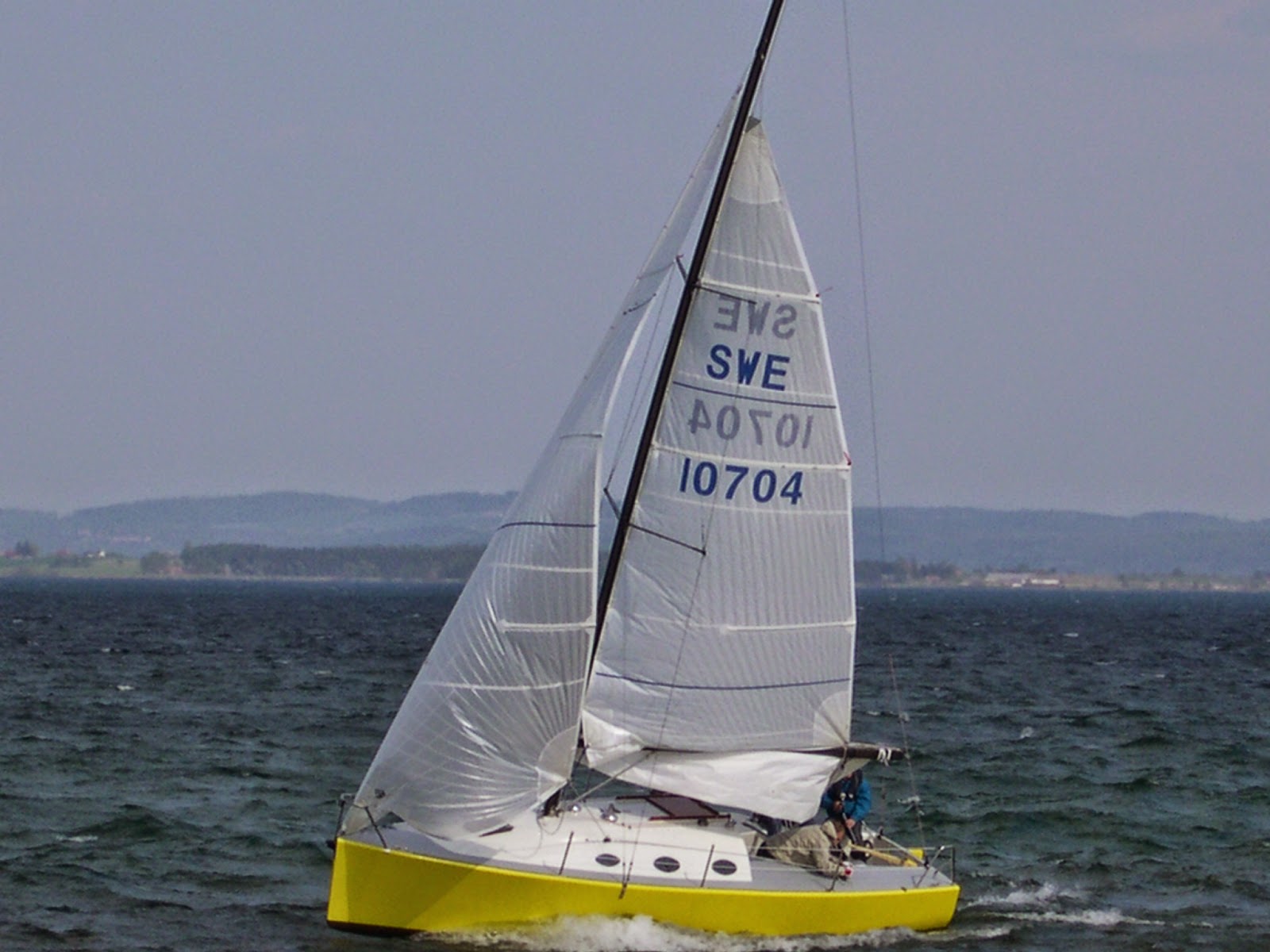 |
| "Butterfly" on an early sail, in breezy conditions. |
 | |
| A recent photo of "Butterfly" in relaxed mode on Lake V�ttern |
To see more of this and our other designs, please visit http://dixdesign.com/
Martes, Setyembre 16, 2014
Sneak Peak at Cape Charles 32
I started to design the Cape Charles 32 a few years ago, commissioned by a client in Maryland. He passed away without having built the boat and it slid to the back shelf, with other designs having higher priority. There it stayed, waiting for a new client to take it on.
Word did get out about this incomplete design and I occasionally received enquiries about when it would be complete or when they could start building. Somehow there was always too much pressure from other designs on my board. Earlier this year the Cape Charles 32 found a spot on my board and is moving forward again and two will start construction when I have the necessary drawings ready.
In the process it has gone through a metamorphosis, prompted by the change of primary client who helps to steer the direction of the design. Eventually the concept of the original client, of a gaff rigged coastal cruiser with simple traditional layout, will be available alongside the version on which I am now working, as shown here.
The square-top mainsail has been described as the modern equivalent of a gaff rig. It behaves differently from a gaff rig but has some of the same advantages and it is prettier than a leg 'o mutton mainsail. I think that it will work well on this cruiser. As seen here it is preliminary and it may change in some way before completion.
The new client for the Cape Charles 32 likes the interior layout of the Didi 950 and asked if something similar will work for the CC32. When I looked at this possibility I realised that the two boats are almost identical in overall dimensions. The concepts and hull shapes are very different, of course, but in some ways the Cape Charles 32 is the Didi 950 taken back a few steps in time.
The layout will be very comfortable and offers good privacy for two couples or a small family. Full standing headroom extends over all standing areas of this boat because of the horizontal cabin crown. The U-shape galley is very secure at sea, with enough counter area for entertaining in harbour.
Hull shape and construction is very much as for the smaller sisters in this design range. They are the Cape Cutter 19, the Cape Henry 21 and the Cape May 25. The family is growing.
With a draft of 1.2m (3' 11"), the Cape Charles 32 will be a good boat for thin water cruising. If you do run her aground, you can hop over the side to push her off again. That will get you into private anchorages that are out of bounds to deep keel cruisers.
To see our full range of designs, please visit http://dixdesign.com/.
Read More..
Word did get out about this incomplete design and I occasionally received enquiries about when it would be complete or when they could start building. Somehow there was always too much pressure from other designs on my board. Earlier this year the Cape Charles 32 found a spot on my board and is moving forward again and two will start construction when I have the necessary drawings ready.
In the process it has gone through a metamorphosis, prompted by the change of primary client who helps to steer the direction of the design. Eventually the concept of the original client, of a gaff rigged coastal cruiser with simple traditional layout, will be available alongside the version on which I am now working, as shown here.
 |
| Preliminary Marconi rig for Cape Charles 32 |
The new client for the Cape Charles 32 likes the interior layout of the Didi 950 and asked if something similar will work for the CC32. When I looked at this possibility I realised that the two boats are almost identical in overall dimensions. The concepts and hull shapes are very different, of course, but in some ways the Cape Charles 32 is the Didi 950 taken back a few steps in time.
 |
| Cape Charles 32 Accommodation |
 |
| Profile and Underbody of the Cape Charles 32 |
With a draft of 1.2m (3' 11"), the Cape Charles 32 will be a good boat for thin water cruising. If you do run her aground, you can hop over the side to push her off again. That will get you into private anchorages that are out of bounds to deep keel cruisers.
To see our full range of designs, please visit http://dixdesign.com/.
Sabado, Setyembre 13, 2014
International Cape Cutter Week 2015
The Cape Cutter 19 is a popular little gaff cutter that I designed for Nick Voorhoeve of Cape Cutter Yachts. Originally built in Cape Town and exported to UK, production moved to UK when Honnor Marine bought the company. Since then many boats have been built and rumour has it that the factory currently has a waiting list for boats to be built. In addition to more than 100 GRP boats, more than 60 have been or are being built by amateurs, from plywood.
This pretty little gaffer sails very well and has earned a very loyal following. Her character and sailing characteristics have resulted in bigger sisters coming off my drawing board as well, the Cape Henry 21 and Cape May 25. The Cape Charles 32 is now part way through the design process.
Earlier this year a group of GRP Cape Cutter 19s met in Cornwall to sail together in the first International Cape Cutter Week. After a successful event, they have now announced their plans for International Cape Cutter Week 2015, from 23-31 May 2015. The sailing area will be on the rivers and waters surrounding Suffolk Yacht Harbour on the River Orwell. For this event they hope to also have entries from Europe.
International Cape Cutter Week 2014 from Charles Erb on Vimeo.
If you have a Cape Cutter 19 or are building one and you are in UK or Western Europe, this is an event that you might consider as a holiday destination for next year. You will meet others with their boats, cruise in company, learn from each other and no doubt have a great time. I have been invited and hope to be able to be there. Time will tell whether or not that works out.
The 2014 event was enjoyed by all participants. The 2015 event is getting off to a great start, with three confirmed entries already.
To see more of this design and others from our office, please visit http://dixdesign.com/.
Read More..
 | ||
| Plywood Cape Cutter 19 "Tiptoe" built by Ian Allen in New Zealand. |
Earlier this year a group of GRP Cape Cutter 19s met in Cornwall to sail together in the first International Cape Cutter Week. After a successful event, they have now announced their plans for International Cape Cutter Week 2015, from 23-31 May 2015. The sailing area will be on the rivers and waters surrounding Suffolk Yacht Harbour on the River Orwell. For this event they hope to also have entries from Europe.
International Cape Cutter Week 2014 from Charles Erb on Vimeo.
If you have a Cape Cutter 19 or are building one and you are in UK or Western Europe, this is an event that you might consider as a holiday destination for next year. You will meet others with their boats, cruise in company, learn from each other and no doubt have a great time. I have been invited and hope to be able to be there. Time will tell whether or not that works out.
The 2014 event was enjoyed by all participants. The 2015 event is getting off to a great start, with three confirmed entries already.
To see more of this design and others from our office, please visit http://dixdesign.com/.
Lunes, Setyembre 8, 2014
Didi 950 - Up and Over
This seems to be a period of hull-turning. About 10 days ago I posted about the Didi 26 being turned in Hood River, OR. Now I am doing the same for Mike Vermeersch's Didi 950 in Ohio.
Mike turned his hull this weekend and it went very smoothly and safely. It is a much bigger boat, with more weight that can potentially get out of control and more height needed to successfully accommodate the hull on its side as it goes through the process. Bigger and heavier boats need more care, preparation and equipment than is the case with smaller boats.
Mike chose to turn it using the spit-roast method. This is only one of many methods that I describe in my book "Shaped by Wind & Wave".
Turning by this method is done by attaching axles to both ends of the hull to suspend it on supports (Mike used engine hoists) while it is rotated on the axles. Care must be taken to get the axles on centreline and close to the vertical centre of gravity of the hull, to keep the rotational forces small. In this case Mike asked me for the position of the VCG, which he says proved to be spot-on. Once lifted, he turned it by himself, exerting about 20lb of force to rotate the hull. These photos tell the story.
Thanks Mike Vermeersch for the great photo series.
To see more of this and our other designs, please visit. http://dixdesign.com/
Read More..
Mike turned his hull this weekend and it went very smoothly and safely. It is a much bigger boat, with more weight that can potentially get out of control and more height needed to successfully accommodate the hull on its side as it goes through the process. Bigger and heavier boats need more care, preparation and equipment than is the case with smaller boats.
Mike chose to turn it using the spit-roast method. This is only one of many methods that I describe in my book "Shaped by Wind & Wave".
Turning by this method is done by attaching axles to both ends of the hull to suspend it on supports (Mike used engine hoists) while it is rotated on the axles. Care must be taken to get the axles on centreline and close to the vertical centre of gravity of the hull, to keep the rotational forces small. In this case Mike asked me for the position of the VCG, which he says proved to be spot-on. Once lifted, he turned it by himself, exerting about 20lb of force to rotate the hull. These photos tell the story.
 |
| Spit-roast axles ready to be fitted. |
 |
| Axle bolted to transom. |
 |
| Axle bolted to bow. |
 |
| Axle in chain sling attached to boom of engine hoist. |
 |
| Lifted on engine hoists and turn started. |
 |
| Almost over. |
 |
| Cradle ready for the hull, on castors for easy moving. |
 |
| Safely settled in her new cradle and ready for interior work. |
To see more of this and our other designs, please visit. http://dixdesign.com/
Mag-subscribe sa:
Mga Post (Atom)